- About
- Education
- Research
- Thought Leadership
- Engagement
- News & Events
Back to Top Nav
Back to Top Nav
Back to Top Nav
Back to Top Nav
Back to Top Nav
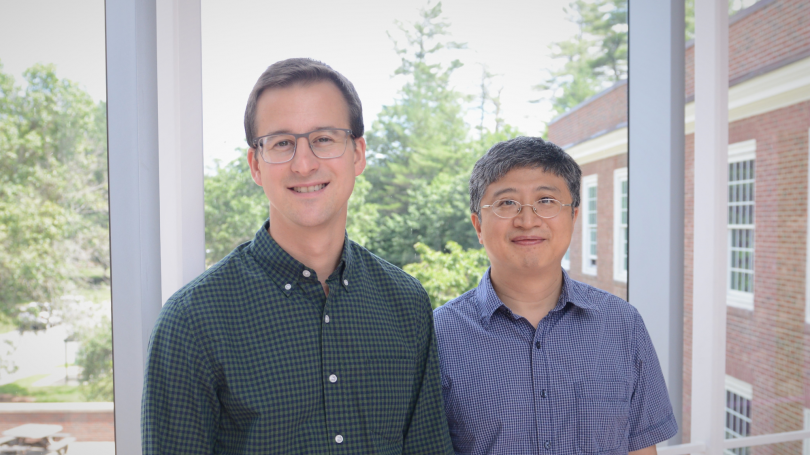
PIs: Professor William Scheideler & Professor Jifeng Liu, Thayer School of Engineering
July 2019 Award Recipient
Solar energy is a clean and abundant carbon-free renewable source capable of sustaining growing global energy needs and mitigating climate change, but deployment on a global, terawatt-scale relies on continued innovation to drive down manufacturing costs. Thin film solar cells, which use light-weight, highly-absorbing semiconductors have the potential to dramatically lower manufacturing costs and accelerate widescale deployment via mechanically flexible architectures. Hybrid metal halide perovskites are the leading materials for this next-generation solar by virtue of their unprecedented optoelectronic properties and their synthesis from earth-abundant elements. The groundbreaking promise of perovskites is that they can be manufactured by scalable solution-coating methods, making them a potentially low-costand high-performance energy technology. However, mechanical fragility, chemical instability, and moisture sensitivityinherent to perovskites must be addressed with new concepts in cell architectures.This proposal designs and developsa novel bifacial perovskite cell architecture that will boost power output by absorbing light from bothfaces and providing robust metal oxide barriers to mitigate thermomechanical degradation. By boosting the power output of these cells, this project aims to dramatically lower solar energy costs ($/kWh) by a factor of greater than 2X compared to the currently projected minimum sustainable pricing for monocrystalline Si solar.